Refunds and chargebacks
Money can come back out of an order two ways. You send it back, which is a refund. Or the customer’s bank takes it back, which is a chargeback. They look similar on a statement and are very different in practice.
Refunds
A refund starts with a credit. You credit the lines, and the platform reverses the charge for the part that was paid through Installer.com. See Credit offer lines.
What follows:
- A credit note is issued, if the order has already been invoiced.
- The customer gets a Refund Statement email with the amount, the reference and the credit note attached.
- The money goes back to the method they paid with. It appears on their account within a few business days, depending on their provider.
The refund is not instant, and the timing is the customer’s bank’s, not ours. Tell a customer asking “where is my money” to allow a few business days.
The transaction fee does not come back with it. The payment method took the fee when the customer paid, so it cannot be returned. The customer is refunded in full, and your balance covers the difference. See Transaction fees.
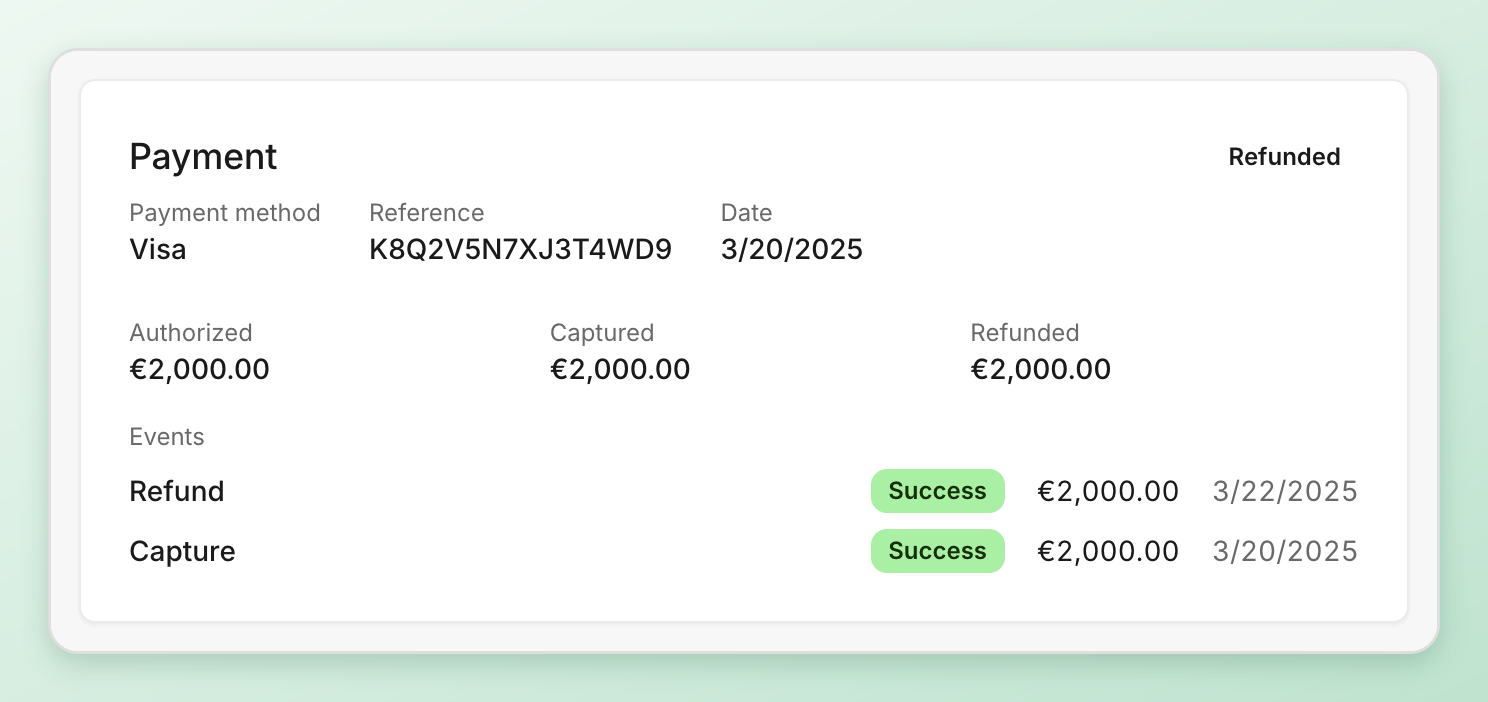
When a refund fails
A refund can fail at the provider, usually because the original payment method is no longer reachable.
The order’s payments page shows a Refund issue panel with the count of failed or uninitiated refunds and a Retry refund action.
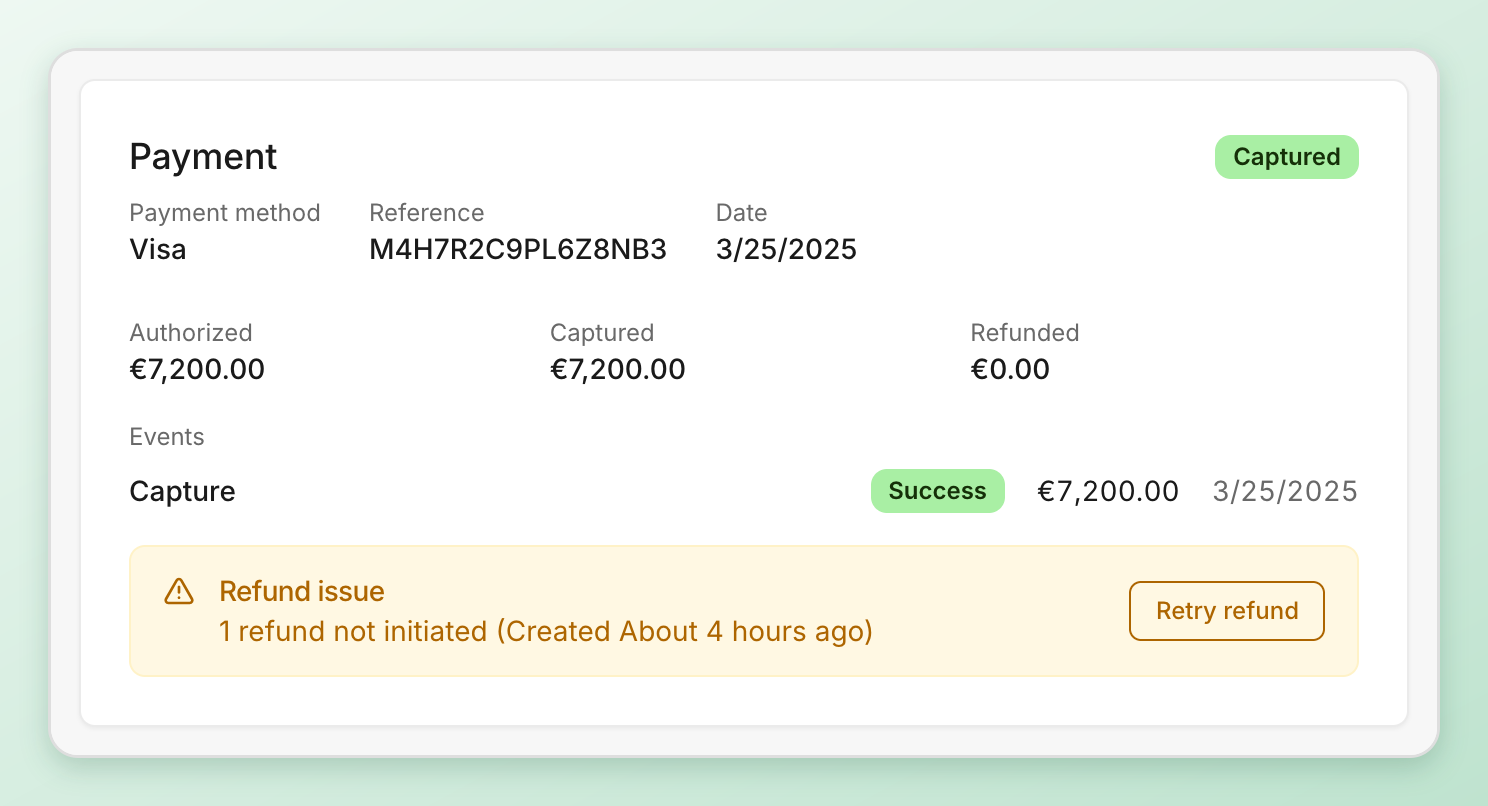
Retry it once. If it fails again, contact support. Do not credit the lines a second time.
Chargebacks
A chargeback is the customer disputing the payment with their own bank. The bank pulls the money back first and asks questions afterwards.
| Stage | What it means |
|---|---|
| Notification of chargeback | The bank has flagged the payment. Nothing has moved yet. |
| Chargeback | The money has been taken back. |
| Second chargeback | The dispute was re-raised after being defended. |
| Chargeback reversed | The money came back to the merchant. |
A chargeback reverses the payment, not the sale. The customer’s invoice stays as it is, and no credit note is issued.
The bank takes the disputed amount from the merchant’s payment account. The merchant is the organisation the customer paid. The amount comes off the merchant’s next payout, and a won dispute adds it back. The installer keeps their pay for the order, and the transaction fee is not returned. Do not credit the lines yourself. Contact support if it needs correcting.
How long a chargeback can arrive
Installer.com sets no window of its own. A customer can dispute a payment for as long as their card scheme or payment method allows. The scheme sets that period, not us.
It is longer than most people expect, and it is measured in months rather than days. So a chargeback can land well after the order is done and the money is paid out. That is why the completion record on the order matters: it is the evidence months later, when nobody remembers the job.
The deadline that is short is the one for answering. Wallet → Disputes carries it per dispute.
Who carries a lost dispute
Chargebacks are uncommon, and a defended one usually turns on documentation the order already holds. It is worth answering them properly.
If one is lost, the customer keeps the refund. The merchant on the order carries the loss. The bank keeps what it took from the merchant’s payment account. The installer’s pay for the order is not reclaimed. Like any payment provider, Installer.com does not underwrite the sale, so the amount becomes a claim against the customer, the same as an unpaid invoice.
Treat it the way you would a customer who refuses to pay an invoice, because commercially that is what it is.
Handling a dispute
Open Wallet → Disputes. It lists every dispute against your payments, with the deadline to respond and the evidence you can supply.
Respond before the deadline. The documentation on the order is usually the evidence that decides it: the signed confirmation, photos and the completion record. It is already attached to the order.
Missing the deadline concedes the dispute.
Which one you want
| Situation | Use |
|---|---|
| The work was not done, or was overcharged | Credit the lines. It is faster and cheaper than letting it become a dispute. |
| The customer says they do not recognise the charge | Point them at the order and the payment reference. Adyen appears on their statement as the processor. |
| The customer has already gone to their bank | It is a dispute now. Respond in Disputes. |
Was this helpful?